
 I thought it would be a really good idea to share interesting interview questions, especially the ones that caught me off guard!
I found this title to be a very interesting question… I’m not sure it was intended as an open-ended question, as I don’t think there is a right or wrong answer. It really depends on your perspective. Are you looking at it from a purely technical or logical (modeling/solution) perspective? Even though I might be considered very technical, I prefer to stay out of the really low level stuff. Sure it is fun, to get down to the bare metal once in a while, but I get more enjoyment out of the thought process. Claiming to be a very Object Oriented person and stumbling on this question really bothered me… I came home and did some Googling, but really never found the answers that seemed to live up my expectations. Next, I sent an mail to one of my pals who just loves the nuts and bolts… In his typically witty way, he rattled off: int, float, boolean, double, long, and char. A completely valid answer! He then have me six other bullets which I have merged into the table below and tried to expand upon.
| Reason | Explanation |
| Primitives | The interviewer lead me with this one, which it is actually pretty obvious when you think about it! This is really not disputable, primitives are not truly objects. I think for historical reasons, namely performance and ease of use, developers were pushed to primitives. With modern JVMs and Java 1.5 autoboxing, I feel like this flaw is slightly minimized. However, from a purest OO perspective this is a valid reason. |
| Constructors | The interviewer also talked about the limitation where constructors can only return an instance of itself, the specific class; which has lead to the creation of factory patterns and DI frameworks. Having been a Spring Framework fanatic for so many years, I have probably developed a different style of programming which as shielded me from this issue. With some of the more dynamic OO languages, you can apparently return a different type instance from the constructor. I need to study some more on this, but did find an interesting Ruby thread. Ruby is definitely on my learning list, so I have to stop blogging! |
| First Class Objects | This reason takes us to pure object orientation. I’m going to gloss over this a little and let you read more on your own as I did today, try this simple search. One of the more obvious distinctions, would probably be the meta data / class model provided by Java. |
| Statics | This is actually one of my pet peeves. I am a no fan of static methods. For me it is simple, statics equal functions which equal non object oriented. I have always bought into the DI propaganda which states that static objects and methods are untestable, which I fundamentally agree with. However, I did recently discover there are are several mocking frameworks that can actually mock out static classes and methods. This is pretty cool, but unnecessary in my preferred design and implementation style. |
| No Multiple Inheritance | Coming from a C++ background, this was always a big discussion point. I generally did not recommend multiple inheritance, as it was tricky and usually implemented (and even modeled) inappropriately. I was much more interested in inheriting behavior rather than state. If I remember correctly, this is where it got interesting using C++. Java Interfaces do a little bit to address this issue, but there is typically no why to elegantly solve the problem without a little code duplication and/or helper classes. |
| Strings | My nuts and bolt friend gave me this one; not sure where he was going, but obviously the Java String class is its own unique creation. Personally, I was always bummed by the lack of a mutable String class. I might have prefer to see non-mutability implemented via subclasses, or something like the Collections.unmodifiableCollection() method. How about that, another static method reference! Maybe this would have been a little better, stringInstance.getImutable()! |
| Limited Operator Overloading | Having done a lot of C++ in my early programming career, I found elegance in operator overloading and saw it as a void in Java. But, I do have to agree with the reason it was left out of Java, “it was used incorrectly to many times in C++”. Unfortunately, you can use any tool incorrectly; it might have been nice to let us decide if and how to use some of these features, rather than eliminate them. I did find an interesting thread on StackOverflow, so I will keep my thoughts short! |
| JNI | This was another bullet from my nuts and bolt friend. In my opinion, JNI was more of a Java after thought, “bolted-on” to simply to take advantage of existing solutions and provide some level of extensibility. I have not used JNI for many years, and all I can remember is procedural nature of our solution. I don’t remember details, other than it was ugly! You could also say that ugly is not object oriented! |
| Package Level Scope | Late breaking addition. I personally never liked the “package” level scoping provided by Java. How is this object oriented? You are basically breaking the class level encapsulation, allowing all classes in that package access… This always felt like a little implementation hack to me… not one of my favorites! |
My thoughts might not be completely baked, but I need to keep on moving; so please let me know if you think I missed the point! Generally speaking, I have been very happy with Java as a implementation language. All languages have their warts, and Java is no different. The vast number of tools and frameworks allow Java applications to be effectively developed, tested, and deployed. I also believe that Java is pretty forgiving, allowing developers of all levels to build solutions; from being barely object oriented to insanely obscure. Hopefully, we end up in the middle with simple elegance. I hope to have the opportunity to explore some of these Java flaws in a Ruby, so please check back and see what I have learned!


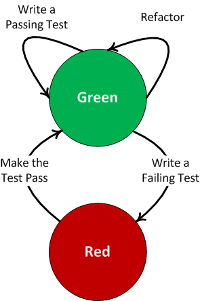

 I am kind of tied to Eclipse as my IDE, but do play with NetBeans every so often. I think I could switch to NetBeans, my only real requirement is that the IDE must have Emacs key bindings; some habits are just too hard to break! NetBeans looks like an pretty good tool and seems to be very responsive on my Ubuntu box; I especially like the way it manages plug-ins. One interesting thing that NetBeans does (maybe a little better than Eclipse), is manage unit testing. NetBeans will automatically create the secondary source tree, but seems to default to in-package testing. It is very easy to add the additional test package into the package structure to enable API testing. I also like the way that NetBeans separates the Test Libraries from the regular Libraries. I’m not sure how well this would work when you use a tool like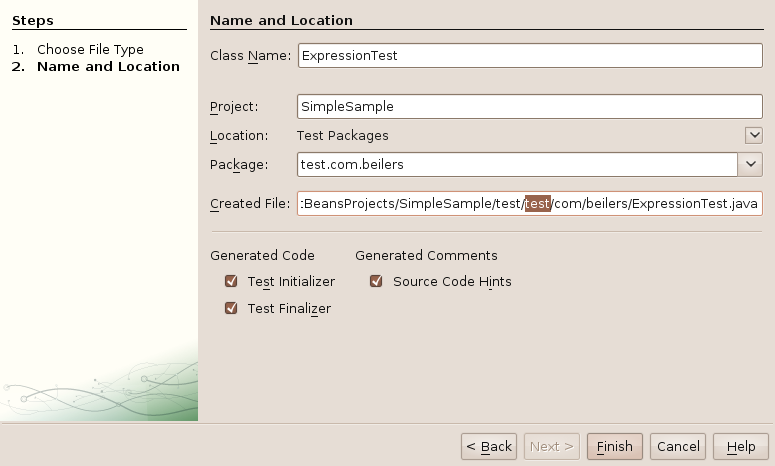
 While looking for the title to my post, I have found a little snippet that calling “
 Factories are so 1990. This is one hurdle that some developers have a tough time understanding. They continue to think about creating objects via factories. There is NO need to ever create a factory when using Spring. Spring is essentially the a super factory, plus it is actually responsible for the life-cycle of those vended objects. There are scenarios where you need to specifically create objects that Spring manages, in a loop for example; but these are very uncommon. The proper way to solve this problem, is to create a bean that is
 This was an unusual one for me. I recently observed a project that used Spring to created multiple static Singleton factories to vend out a variety of instances, each factory with it’s own Spring context file. Needless to say, this application was far from easy to understand. To my surprise, there was even a factory specifically implemented for creating the business domain objects. Why this was done is still a mystery to me and seems to violate the true spirit of Spring. Why would I ever want to call DomainFactory.getNewWidget() or DomainFactory.getNewGadget()? The configuration had the domain beans defined in a separate Spring context file and oddly, used static methods to initialize specific properties of these new bean instances. There was no way which enabled the XML configuration to be overridden, allowing for different implementations. Worse yet, you were tied to the initialization behavior of the factory methods! Depending on your definition of a domain object, I see very little reason domain object dependency injection.
 This is an interesting use of Ant in a Spring-based application. The idea here is to generate the Spring configuration and properties file from an Ant task, to specifically configure the context files to each deployment environment. They values are essentially baked into the application and unchangeable. It is bad enough to substitute property file values, but some developers actually substitute bean name references. This might be a little hard to follow, but the Spring XML configuration would define two different implementations of the same basic function, each with its own name. When the application is built, the Ant tasks would substitute ref=”bean1” for some environments and ref=”bean2” for others; everywhere that implementation was referenced in the configuration files. Call me crazy, but I don’t think this what the Spring creators ever intended!
 I have been so busy with work and life, that my blogging had basically stopped for the summer. I keep sending myself topics and notes about things that I would like to write about. Unfortunately, I have not had a chance to do anything with them and the topics keep piling up! I was talking with one of my coworkers last month, and he mentioned that he also had a blog. I mailed myself the link to his site,
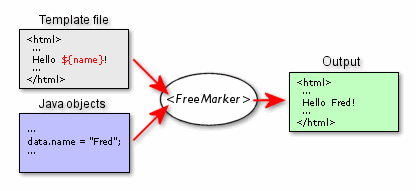 I liked the Freemarker overview picture, taken from the
  These are not really new features, but I bet most developers (like myself) have not given them the attention they deserve! Earlier this month, I read an interesting article on the
 I was working on a typical web portal application today and needed to support a multi-file download. Luckily, I had some code which I had used several times before. I started to tweak it for my specific requirements, realizing it was such a bad fit, I quickly tossed it out. My previous implementation worked with physical files and was tightly coupled to a legacy framework. This time, the files were already in memory. I was hoping to find some code that allowed me to build the zip file in memory, rather than dealing with the file system and temporary files. Since the portal user could only download a limited number of files at one time and the files were very small, I didn’t have to worry about memory constraints.